Nobody Knew: My Whole Life, and the Disease Underneath It
When I was seventeen, I lost 124 pounds in fifteen weeks, and instead of anyone stopping me, everyone clapped.
My name is Cash. I am a teacher, a coach, and a person in long-term recovery from alcoholism, eating disorders, depression, and complete apathy. Most people who know my story know about the drinking, because the drinking was loud. This is the story underneath it. The eating disorder was my first disease, it was the quietest one, and it was the one nobody saw, because from the outside it looked exactly like success.
The happiest guy in the room
I grew up as the kid who was great at everything. I was the happy-go-lucky one, the one who made the room laugh, the one who led the team and got the grades. In my senior class superlatives at Northview High School in Johns Creek, Georgia, I won Most Spirited. That is the person people saw, and that person was real. He was also carrying a secret every single day.
I felt like I had to be the best all the time. Over the years that grew into needing to be the best at everything, including the best-looking person in the room. When you live like that, there is no such thing as good enough, and there is no such thing as a little. There is only all or nothing.
The first disease
My eating disorder started when I was seventeen, in Georgia. It was anorexia and bulimia. In my junior year at Northview, I stepped on the scale at 303 pounds. That same year I wrestled in the 179-pound class. The distance between those two numbers is 124 pounds, and I covered it in fifteen weeks.
I am not going to describe how I did it, because the method is not the point and it never helps anyone to hear it. Here is the point: what I was doing to my body was legal, it was visible, and it was praised. Coaches praised it. Classmates praised it. Adults I respected praised it. Nobody asked how a teenager could lose that much that fast, because the answer they wanted was "discipline," and I was happy to let them believe it.
That applause is the most dangerous part of this whole story. When the world rewards the thing that is killing you, you do not stop. You dig in. Every compliment told me I was right, and every compliment made the secret heavier, because now I had something to protect. I had two lives: the one everybody clapped for, and the one I hid.
The man who taught me to eat
My parents saw enough to know I needed real help, and they paid for it. They found Mark Macdonald, the founder of Venice Nutrition and the author of Body Confidence. Over time, Mark convinced me of something I did not believe at first: that if I ate the right way, consistently, I would not need to purge and I would not need to skip meals, and my body would do what it was built to do.
What Mark taught me was real, and it worked. I want to say that plainly, because he deserves the credit. He taught me most of what I know about getting through the eating part of an eating disorder.
But eating right did not set me free, because the disease was never only about food.
I didn't get better. I changed seats.
I stopped one behavior, and another one took its place. For four straight years, through my junior and senior years of high school and my first two years of college, I got up before dawn every day and trained for hours, in several sessions a day. On top of that, I took diet pills, including Hydroxycut. On May 1, 2009, the FDA warned people to stop using Hydroxycut products immediately because of reports of serious liver injuries, including one death from liver failure.
Everyone called it discipline. They called me dedicated. They called me an athlete. In addiction, the thing I was doing has a name: cross-addiction. It means you stop one compulsion and the same engine moves into another one. You do not get better. You change seats.
That is the hardest thing to explain to people who have never lived it. An eating disorder is not a diet that got out of hand. It is the same machinery as addiction: the secrecy, the lying, the hiding, the shame, the need for more, the all-or-nothing thinking, and the trading of one behavior for another. I was learning every one of those behaviors as a teenager, and I was getting applause for it.
The life on the outside
From the outside, my life kept looking like a highlight reel.
I went to the University of Mississippi, where I studied history with a minor in Chinese Language and Literature, and I spent a semester at Beijing Language and Culture University. I graduated in December 2014. I worked for four months at a publishing company in Atlanta, and then I moved to New York.
From 2016 to 2020, I taught high school history and coached in Charleston County, South Carolina. I was the head baseball coach, the assistant head coach for basketball, and the offensive coordinator for football. I loved those kids, and I still do. Teaching and coaching are the truest things I have ever done.
I also co-owned a travel agency from 2016 to 2021, and from 2017 to 2025 I directed marketing for a villa estate in the Dominican Republic.
Every one of those lines is true, and every one of them would look great on a resume. None of them tells you what was happening inside me while I was doing them.
The same engine found the bottle
Eventually the engine that had run my eating disorder found alcohol. The all-or-nothing that drove the starving and the training now drove the drinking, and it was the same behaviors in a different bottle: the hiding, the lying, the shame, the promise that tomorrow would be different. Depression came with it, and so did a kind of complete apathy, where nothing felt worth doing at all.
I have relapsed nineteen times. One of those relapses came after two years of sobriety. I say that number out loud because somebody reading this has relapsed five times, or ten, and believes it means they are finished. It does not. It means they are still here.
The place that put it together
I went to more than one rehab. The Refuge was the only one I went to that treated the eating disorder, the alcoholism, and the PTSD together, as one person instead of three separate problems. There I did EMDR, which is a trauma therapy that uses guided eye movements while a person works through a painful memory.
At The Refuge I finally heard what nobody had told me in all those years: eating disorders and addiction are connected. When the body does not get what it needs, the brain gets pushed into fight-or-flight, and that state feeds straight into the drinking. Almost nobody in the addiction world talks about this, and they talk about it with men even less. I had a therapist there who helped me see my whole life as one story instead of a pile of separate failures, and I will be grateful to her for the rest of my life. Dankeschön.
Halsey
I came home from rehab in the fall of 2024 with nothing. My golden doodle, Halsey, was waiting for me. Two weeks after I got home, on election night, November 5, 2024, Halsey died.
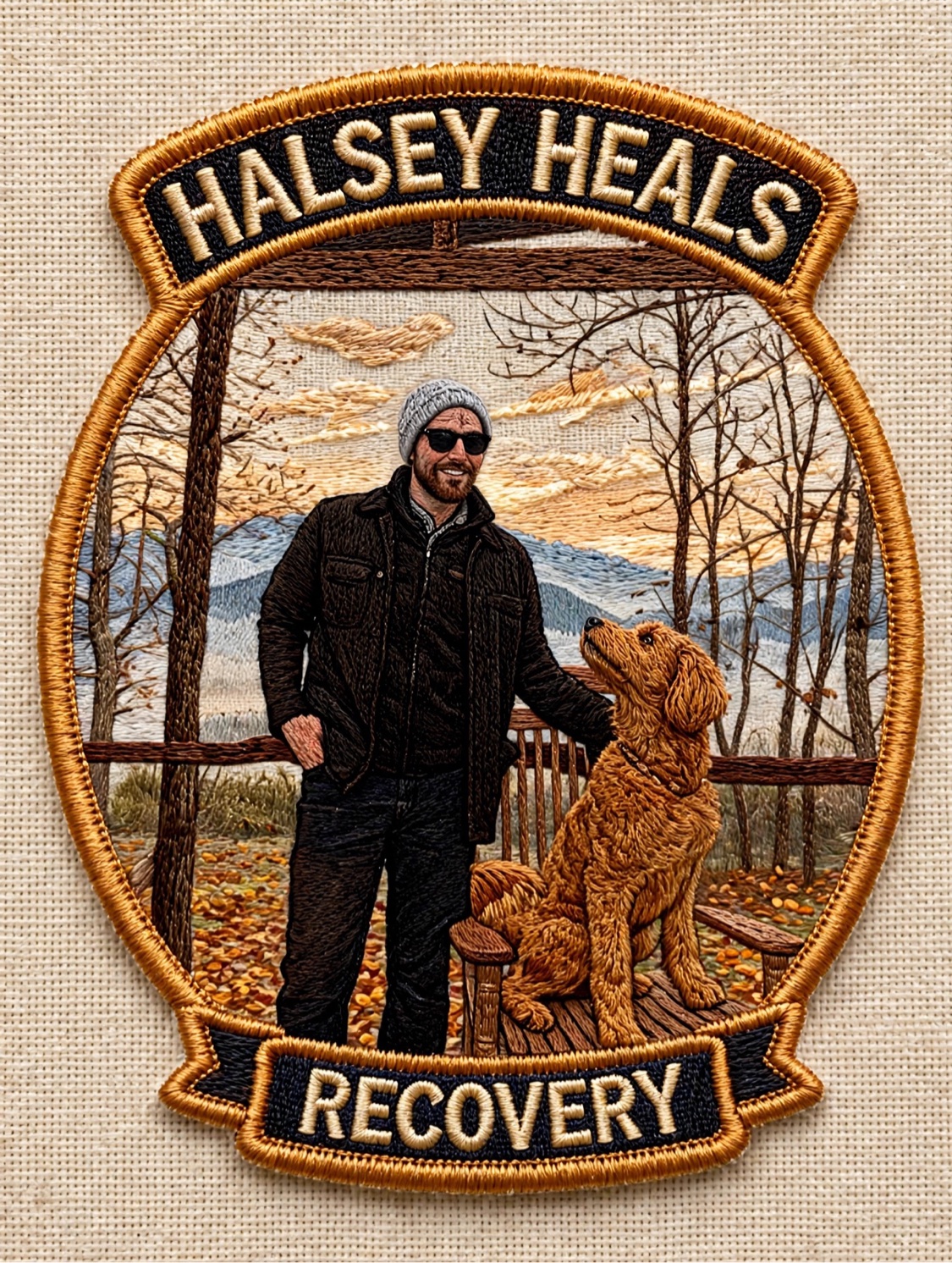
I could have let that be the thing that finished me. Instead, I put her name on the work. Halsey Heals is named for her, and everything I build now carries her name.
What I do now
Today I live in Winter Park, Florida, and I run Halsey Heals Recovery. We offer coaching for people and for families. Coaching is a service. It is not treatment, therapy, counseling, or detox, and it never replaces a doctor or a licensed therapist. What it does is walk beside a person and a family while they find the right help and learn how to live again.
I also built a school. Its first course, How to Win, is free. The school is built on one idea: that a person who believes their life is over can learn how to learn again. I call the old books cheat codes, meaning tested instructions for a life, and the school teaches people to actually run those codes in their own days instead of just reading them.
And I carry a simple message, the one I wish someone had carried to my family when I was seventeen: families seek help first, and nobody has to carry a secret alone.
The code
Here is the code this story taught me. A disease that is praised is still a disease. If someone you love is losing weight fast and everyone is applauding, ask the question nobody asked me: "Are you okay, and how are you doing this?" Then listen to the whole answer.
If you are the one carrying the secret, you are not weak, you are not finished, and you are not alone. I was you. I see you.
The one thing to do today is this: tell one person the truth, or make one call. If you are a parent, make the call for your family first, even before your child is ready.
If you need help now
National Alliance for Eating Disorders Helpline: 866-662-1235. It is free, it is staffed by licensed therapists who specialize in eating disorders, and it is open Monday through Friday, 9 AM to 7 PM Eastern. They help people who are struggling and the families who love them.
988 Suicide and Crisis Lifeline: call or text 988, any time, day or night.
If you or someone you love is in immediate danger, call 911.
Where to go next:
- Free resources for people and families: halseyheals.com/resources
- Coaching for people and families: halseyheals.com/coaching
Halsey Heals Recovery offers coaching, which is not medical care, treatment, therapy, counseling, or detox. If you are struggling with an eating disorder, please also reach out to a doctor or a licensed eating-disorder specialist.